Your Facelift Recovery Timeline: What to Expect Day by Day
What to Expect: Facelift Recovery Time at a Glance
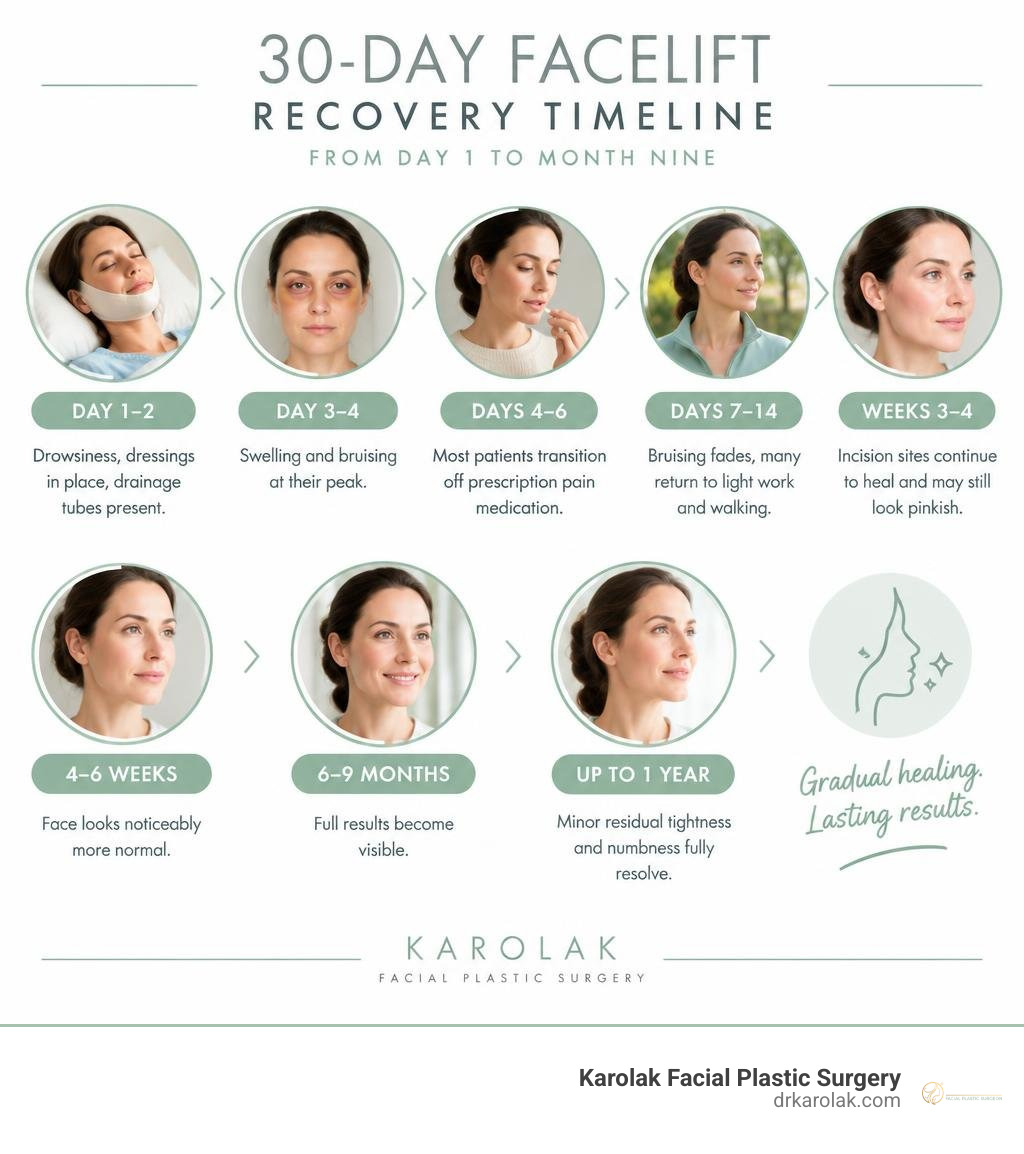
Facelift recovery time typically follows a predictable path: most people feel like themselves again within 2 to 4 weeks, though the full results continue to develop for months.
Here is a quick overview of what to expect:
| Timeframe | What’s Happening |
|---|---|
| Day 1-2 | Drowsiness, dressings in place, drainage tubes present |
| Day 3-4 | Swelling and bruising at their peak |
| Days 4-6 | Most patients transition off prescription pain medication |
| Days 7-14 | Bruising fades, many return to light work and walking |
| Weeks 3-4 | Incision sites continue to heal and may still look pinkish |
| 4-6 weeks | Face looks noticeably more normal |
| 6-9 months | Full results become visible |
| Up to 1 year | Minor residual tightness and numbness fully resolve |
A facelift, medically known as a rhytidectomy, can turn back the clock on sagging skin, jowls, and neck laxity. But like any surgery, it comes with a recovery period that deserves honest preparation.
The good news? Most of the visible signs of surgery resolve within two weeks. The less discussed reality is that subtle healing continues for up to a full year. Understanding this timeline helps patients plan smartly and set realistic expectations, so the process feels manageable rather than overwhelming.
Mark Karolak is a facial plastic surgeon based in Martinsville, New Jersey. Facelift recovery time is one of the most important topics discussed with patients before surgery. This facial-only surgical practice has guided hundreds of patients through every stage of the recovery journey.
Understanding the Facelift Recovery Time Timeline
For patients from Wall Township, Rumson, and across the Tri-State area, the primary question is often: “When does the face look normal again?” The answer is best understood by viewing recovery as a series of overlapping healing stages. The body does not heal overnight, but it does heal systematically.
While the surgical details of a rhytidectomy involve lifting the deep SMAS (Superficial Musculoaponeurotic System) layer and trimming excess skin, the day-to-day focus after surgery should be on managing swelling, resting, and watching new contours emerge. Clinical resources like the Facelift (rhytidectomy) – NHS emphasize that patience is an important part of this period, as initial bruising and distortion are normal parts of the process.
Here is a closer look at the first 30 days and what is happening under the surface.
Week 1: Managing Peak Swelling and Early Healing
The first seven days are the most dynamic and require the most discipline.
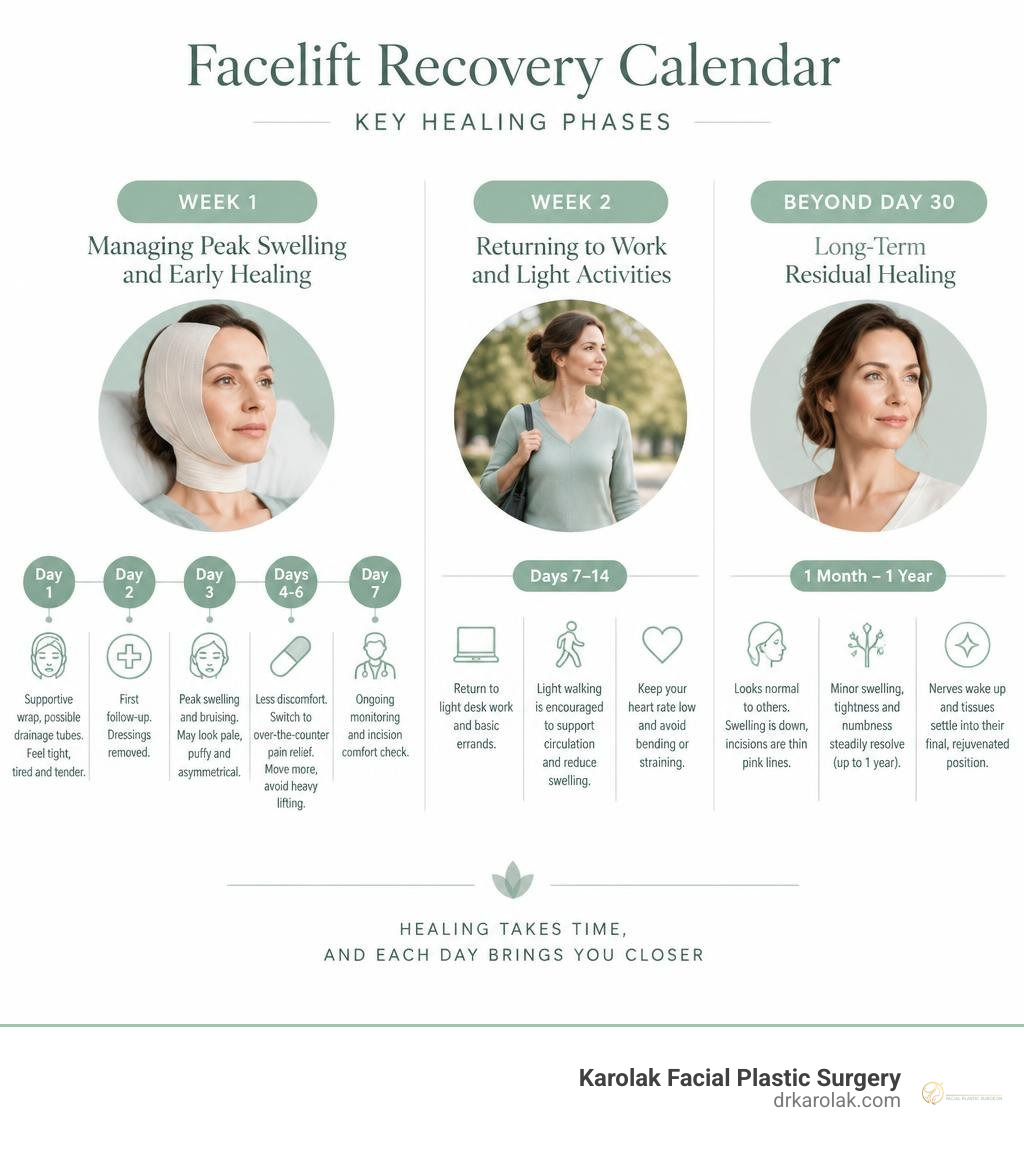
- Day 1 (The Immediate Post-Op): Patients wake up with a supportive wrap around the face and head. If surgical drainage tubes were placed to prevent fluid accumulation, they will be in position. Tightness, fatigue, and tenderness are common. A trusted friend or family member should drive the patient home and stay the first night.
- Day 2 (The First Follow-Up): This is often the day for an office visit, when the surgical team carefully evaluates incisions and removes the initial bulky dressings.
- Day 3 (The Peak Swelling Phase): Day 3 and Day 4 are usually when swelling and bruising look most pronounced. This is the peak of the body’s inflammatory response. The face may look pale, puffy, and slightly asymmetrical.
- Days 4-6 (The Transition): By this point, the worst discomfort has often passed. Many patients transition off prescription pain medication and manage remaining tenderness with over-the-counter options. Movement increases gradually, but heavy lifting remains off-limits.
- Day 7: The care team continues to monitor healing progress and incision comfort as the acute recovery phase begins to ease.
For a detailed breakdown of handling these first critical days, see Post-Op Facelift Care.
Week 2: Returning to Work and Light Activities
During days 7 to 14, daily changes become highly encouraging.
The heavy, tight sensation begins to ease, and deep purple bruises fade into lighter yellowish-green hues. By the end of the second week, many patients feel comfortable returning to light desk work and running basic errands.
Light walking is often encouraged during this phase because it promotes healthy circulation and may help clear residual swelling. However, “light” is the keyword. Keep the heart rate low and avoid activities that involve bending over or straining.
For guidance on returning to a professional routine, see When Can I Go Back to Work After a Facelift?.
Beyond Day 30: Long-Term Residual Healing
By the one-month mark, the face often looks remarkably normal to a casual observer. Major swelling has subsided, and incisions are healing into thin, pink lines that can often be concealed with makeup or hair styling.
However, healing does not stop at day 30. It can take up to a full year for minor swelling, tightness, and localized numbness to completely resolve. These residual sensations are typically noticeable only when the cheeks or neck are touched. Nerves are waking up, and deeper tissues are settling into their permanent, rejuvenated positions.
For more on this extended healing window, explore Facelift Recovery Time.
Essential Postoperative Care for Optimal Healing
The smoothest recoveries do not happen by accident. Patients who carefully prepare a recovery space and strictly follow postoperative instructions often experience an easier healing journey and beautiful, natural-looking outcomes.

For added preparation, review 5 Tips to Your Best Facelift Recovery and the curated Tips for Facelift Recovery. The following are foundational rules of postoperative care.
Sleeping Positions and Head Elevation
Gravity can either be helpful or unhelpful during early facelift recovery. To minimize swelling and prevent fluid from pooling in facial tissues, keep the head elevated at approximately a 30-degree angle for the first week after surgery.
This is often easiest with 2 to 3 comfortable pillows or by sleeping in a recliner chair. According to the Facelift: MedlinePlus Medical Encyclopedia, maintaining an elevated position for the first few days is an important step in minimizing postoperative swelling.
What is the typical facelift recovery time for returning to work?
While every individual heals at a different pace, the two-week mark is a common milestone for returning to work.
- For desk jobs: A primarily sedentary job may allow a return after 10 to 14 days. Light bruising may still be present, but it can often be covered with camouflage makeup once incisions have closed.
- For physically demanding jobs: Jobs involving heavy lifting, bending, or intense physical exertion may require at least 3 to 4 weeks before a return to full duty.
For more help planning time away from work, see How Long is Recovery From a Facelift?.
How Anesthesia Choice Impacts Your Facelift Recovery Time
One often-overlooked factor in facelift recovery time is the type of anesthesia used during the procedure. Many traditional facelifts are performed under general anesthesia, which can leave patients feeling groggy, nauseated, and deeply fatigued for days after surgery.
Karolak Facial Plastic Surgery specializes in natural-looking facelifts performed without general anesthesia, using local anesthesia with twilight sedation instead. This approach can improve the early recovery experience.
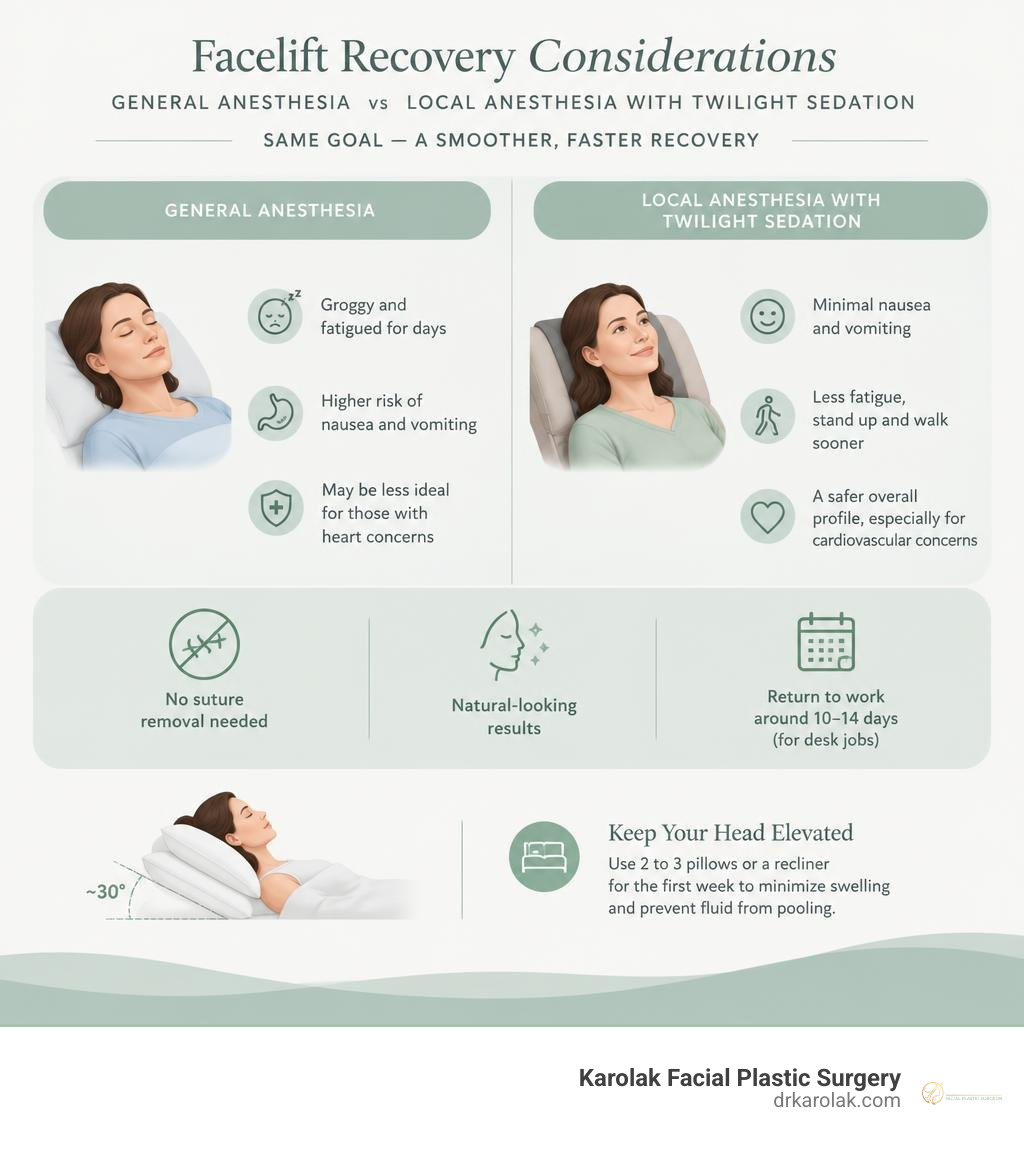
Avoiding general anesthesia may offer patients:
- Minimal postoperative nausea and vomiting, which can reduce the risk of elevated blood pressure and bleeding.
- Less immediate postoperative fatigue, allowing patients to stand, walk, and begin recovery sooner.
- A potentially safer overall profile, particularly for patients with cardiovascular concerns.
Potential Risks, Side Effects, and Complications
While a facelift is highly safe when performed by an experienced, board-certified facial specialist, it is still a major surgical procedure. Awareness of potential side effects and rare complications is essential for patient safety.
- Common Side Effects: Temporary numbness, skin discoloration, moderate swelling, and a feeling of tightness around the jaw and neck are expected. A temporary low mood is also common during the first week as the body processes the physical stress of surgery.
- Hematoma: This is a collection of blood under the skin that occurs in a small percentage of cases. It usually presents as sudden, painful swelling on one side of the face and requires prompt medical attention.
- Seroma and Sialocele: A seroma is a collection of fluid under the skin, while a sialocele is a rare collection of salivary fluid that can occur if the submandibular glands are treated. Both can be managed by the surgeon in the office.
- Nerve Injury: Temporary weakness in facial muscles can occur because of localized inflammation around the facial nerves. While alarming, this usually resolves as tissue heals.
- Infection and Scarring: Infections are uncommon because the face has an excellent blood supply. Following the surgeon’s cleaning and care instructions supports proper incision healing and scars that fade into subtle lines.
Frequently Asked Questions
When is it safe to wear makeup and style hair after a facelift?
Wait at least one full week before applying concealing makeup to the face, and keep it away from healing incision lines until they are completely closed.
For hair care, gently wash hair with a mild baby shampoo starting about 48 hours after surgery, provided bandages do not get wet. Avoid blow dryers, hair dyes, and harsh chemical treatments for at least 4 to 6 weeks.
How long does it take to see the final results of a facelift?
Although many patients look “socially presentable” within 2 to 4 weeks, it often takes about 6 to 9 months to see the final effect of a facelift. During these months, the last traces of micro-swelling disappear, tissues soften, and scars mature into their final, faded state.
Conclusion
Recovering from a facelift is a journey of patience, but the destination can be incredibly rewarding. Understanding the timeline, preparing the home, and partnering with a specialized surgical team can support a smoother transition from swollen to stunning.
Karolak Facial Plastic Surgery has performed over 3,000 natural-looking facelifts and neck lifts in New Jersey. By performing procedures under local anesthesia rather than general anesthesia, the practice helps patients from Toms River, Spring Lake, Colts Neck, and across the Tri-State area pursue beautiful, refreshed results with a safer, more comfortable recovery.
To take the next step toward a refreshed, natural look, read the featured guide, How Long is Recovery From Facelift Procedure?, or contact Karolak Facial Plastic Surgery to schedule a personal consultation.